
A battery developer offers to lease a small part of your property. The proposal mentions a nearby substation, a deadline, and a project measured in megawatts. Why your land? And who decides whether the project can connect?
The answer starts beyond the property line. Illinois participates in two regional electricity systems, PJM and MISO. Their planning, the local utility’s electrical network, and Illinois programs can all affect a storage project. Understanding those roles helps an owner ask better questions before committing land.
Here is the starting point: a battery site needs both a reason to be built and a place where it can connect. Regional demand may help create the opportunity. It does not establish that a particular parcel works.
Have an Illinois location in mind? Request a free preliminary BESS site report for a first look at the property and nearby grid context.
The grid is a network with several kinds of boundaries
Electricity reaches customers through an interconnected system of generators, transmission lines, substations, and local distribution equipment. The high-voltage transmission network moves electricity over longer distances; the distribution network delivers it locally. EIA explains the delivery system.
The contiguous United States has three major physical interconnections: Eastern, Western, and Texas. Illinois is in the Eastern Interconnection. These physical networks are different from market regions, reliability regions, and utility service areas. Alaska and Hawaii have separate systems. EPA’s grid overview.
That distinction matters. A map of the grid’s physical connections answers a different question from a map showing who operates a wholesale market. Neither establishes which utility serves your parcel or whether it has room for a proposed battery.
What “reliability” actually means
In everyday terms, reliability means having electricity available when people need it and keeping the larger system stable when something goes wrong. NERC distinguishes two parts:
- Adequacy: enough available resources to meet customers’ power and energy needs, allowing for expected equipment outages.
- Reliable operation: the system’s ability to withstand a sudden disturbance, such as an unexpected generator or line outage, without an uncontrolled cascading failure.
A hot afternoon tests whether enough supply is available. An unexpected equipment trip tests whether the system can stay stable and respond. These are bulk-system questions; a favorable assessment does not promise that a tree will never take down a neighborhood power line. NERC Glossary of Terms (“Adequacy”; “Reliable Operation”).
Who does what—and where the territories overlap
There is no single national office that owns the grid and directs every project. FERC provides federal oversight within its jurisdiction. NERC develops and enforces bulk-system reliability standards and assesses risks. Its six regional entities carry out delegated regional work. PJM and MISO coordinate operations and wholesale markets. Utilities handle their electrical facilities and the applicable delivery and connection functions. FERC’s explanation of the reliability framework, FERC’s market guide.
Start with the country. Work toward the property.
Choose a layer, then select an organization to look closer.
Viewing: NERC and the wider reliability system
NERC: reliability standards and risk assessments
The North American Electric Reliability Corporation develops and enforces bulk-system reliability standards under the applicable oversight framework and assesses risks. In the United States, FERC oversees this work. NERC is not the local utility or a developer selecting your land.
The striped areas have a specific meaning: some companies responsible for serving customer demand participate in one reliability region while associated transmission owners or operators participate in another. They do not mean that every project in a shaded area has two market operators.
Regional entities: delegated reliability work
These six organizations carry out regional reliability and compliance work. Their boundaries are different from the market map shown in the next layer.
Six regions, one reliability framework
Select a region to magnify the published map and identify the organization.
This is an organizational relationship, not a geographic boundary drawing. ReliabilityFirst’s 2026 report.
PJM and MISO: operating and planning the regional grid
Regional transmission organizations coordinate operations, run wholesale markets, and perform planning and interconnection functions. They are separate from NERC’s regional reliability entities and from the utilities that deliver power.
Compare this map with the reliability map.
The borders answer a different question. ReliabilityFirst includes parts of both PJM and MISO; those organizations are not interchangeable.
Utilities: Ameren Illinois and ComEd
The serving utility is a starting point for the local network and connection process. ComEd is the familiar northern Illinois/PJM context; Ameren Illinois is the familiar central and southern Illinois/MISO context. A parcel’s actual service and proposed connection still need checking.
Ameren Illinois and ComEd
Published ComEd and Ameren Illinois areas are shown. Other providers are not separately mapped and may serve areas within these generalized polygons.
These are generalized retail service areas, not a precise map of RTO facilities or a determination about your parcel.
Utility reporting year 2022 · source date August 2023 · Census state geometry retrieved November 3, 2026.
Published utility geometryComEd: an electric delivery utility serving northern Illinois. ComEd’s explanation of its delivery role.
Ameren Illinois: a regulated electric and natural-gas delivery company. It is distinct from Ameren Missouri and Ameren’s transmission businesses. Ameren’s company overview.
Other utilities, municipal systems and cooperatives also serve Illinois. This generalized map does not determine available capacity, regulatory jurisdiction, or eligibility for a particular site.
For one property, ask three different questions: Who oversees reliability? Who operates the regional market? Who serves the proposed connection?

Use the buttons to move from the national view toward Illinois. NERC’s map includes striped areas where some companies responsible for serving customer demand (load-serving entities) participate in a different reliability region from associated transmission owners or operators. That is a specific kind of overlap. A reliability region and a market region can also cover some of the same geography while having different boundaries and responsibilities. Sources: NERC’s January 2026 strategic plan, p. iii, FERC’s U.S. market map.
Illinois programs and project approvals add another set of responsibilities. The ICC, IPA, and applicable local authorities have different utility-regulation, procurement, and land-use functions. They are not the next departments in a single grid company.
Why Illinois owners hear about both PJM and MISO
For many owners, the useful starting point is ComEd and PJM in northern Illinois, and Ameren Illinois and MISO across much of central and southern Illinois. Municipal utilities, cooperatives, other utilities, and transmission arrangements mean this shorthand cannot replace checking the property and proposed connection. PJM’s Illinois overview, Illinois procurement geographical definitions.
In the explorer’s Illinois utility view, the map shows generalized utility service areas, not an RTO boundary survey or parcel-level eligibility map. The underlying published utility geometry uses 2022 reporting data, with a 2023 source date. Other providers are not separately mapped, and the generalized polygons may contain areas served by them. Confirm the actual serving utility and connection point for any project.
In practical terms, a developer considering a distribution-connected battery will need to investigate the local utility’s network. A project seeking transmission connection has a different study path. Participating in a regional market is another question: physical connection and market participation are related, but they are not the same thing.
What are the grid assessments actually assessing
Reports about “resource adequacy” ask whether enough dependable resources will be available when customers need electricity. Transmission planning asks whether the network can move electricity where it is needed. Project-specific interconnection work examines what happens when a proposed facility connects at a particular location. MISO’s resource-adequacy explanation.
Think of these as three questions:
- Enough supply: Will resources be available during the hours of need?
- A workable route: Can the network deliver the electricity?
- A workable connection: Can this battery charge and discharge at this location, and what upgrades would it require?
A favorable regional report cannot answer the third question for your land. Likewise, a nearby substation or a line with an impressive voltage does not tell you how many megawatts are available for a new project.
The date and scope of a report also matter. A ten-year outlook and a summer assessment can reach different conclusions because they examine different periods and conditions.
ReliabilityFirst is an organization, not another term for reliability. It is one of NERC’s six regional entities. Its region includes Great Lakes and Mid-Atlantic areas and parts of both PJM and MISO. It evaluates risks and performs regional reliability and compliance work; PJM and MISO remain separate operating and market organizations. Who is ReliabilityFirst?, ReliabilityFirst’s 2026 resource-adequacy report.
For example, ReliabilityFirst’s Summer 2026 assessment described adequate resources for typical demand in PJM and MISO. MISO’s October 28, 2026 winter outlook likewise reported sufficient capacity for expected conditions, while identifying challenges from extreme weather and operations. Those findings can coexist with concerns about future demand and the pace of new development. Summer assessment, MISO winter outlook.
Why batteries are part of the response
Storage gives operators flexibility about when energy is used. Batteries can take energy from the grid and return some of it later, or respond quickly when operating conditions change. Their value depends on the service, location, and operating arrangements. EIA’s storage explanation.
The opportunity comes from several forces. PJM’s January 2026 forecast projected substantial longer-term demand growth while revising some near-term expectations downward. MISO’s 2026 Reliability Imperative describes pressures from large loads, changing resources, and development delays. These are planning challenges with several possible responses, including new generation, transmission, demand response, and storage. PJM forecast, MISO report.
A reliability report identifies a need or risk. Market arrangements and public policy help determine whether a developer can finance a response. The developer still needs a suitable site, approvals, and a viable electrical connection.
Where a BESS system sits in the grid
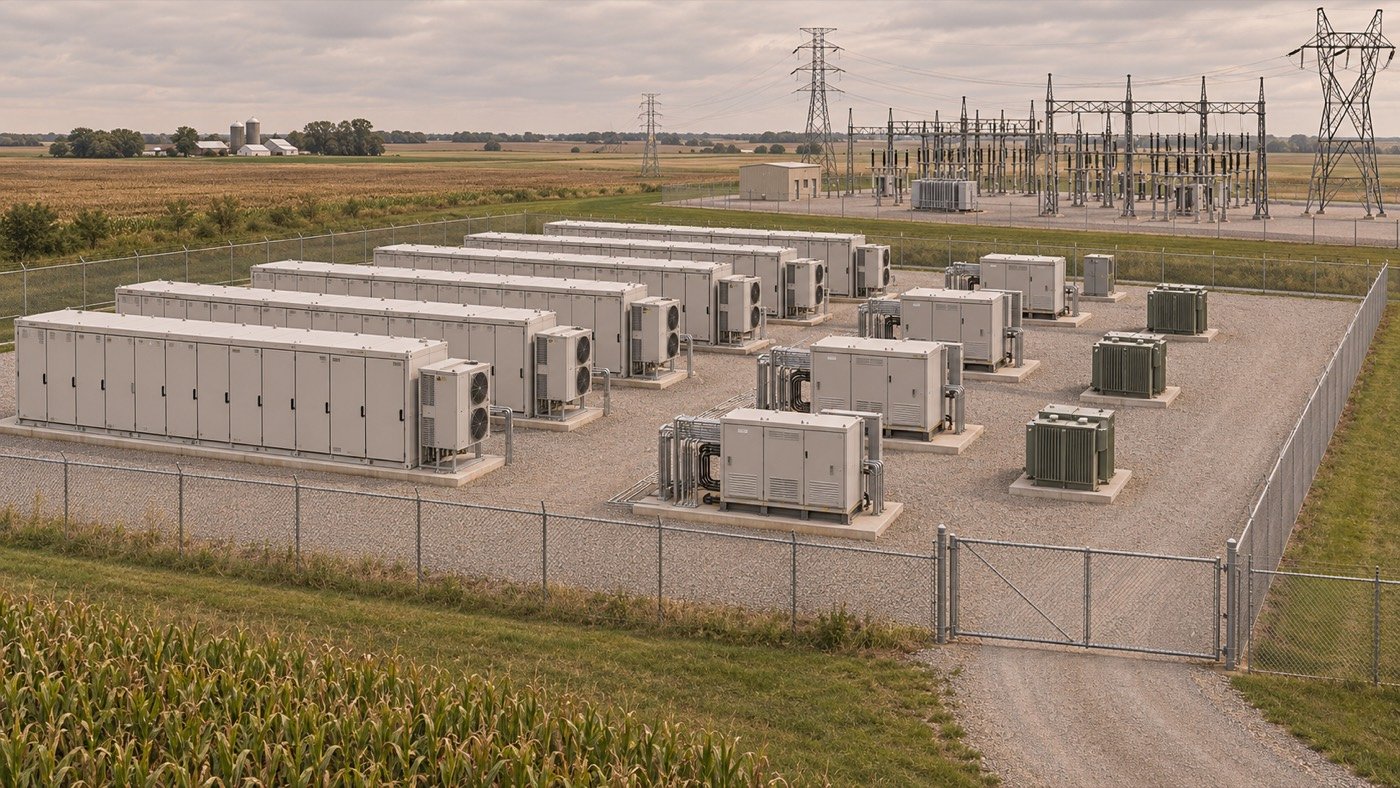
“BESS” means battery energy storage system. It can connect at different points. A distribution-connected system uses the local network; a transmission-connected system connects at the higher-voltage network. A customer can also have storage behind its meter. This article’s illustration focuses on the first two configurations.
Where the facility connects

In the interactive version, switch the connection and select charging or discharging. The arrows illustrate energy exchange; they do not show a dedicated route to a particular customer, actual dispatch, or available connection capacity.
A battery is not an unlimited source of new energy. It needs charging, has losses, and can discharge only for as long as its available stored energy allows. A storage facility near homes also does not automatically provide those homes with backup power during an outage. Backup service needs the appropriate electrical design and operating arrangements. EIA storage applications and microgrids.
Understand both numbers in a battery proposal
Megawatts, or MW, describe power: how quickly a system can deliver or take in energy. Megawatt-hours, or MWh, describe an amount of energy.
As a simple illustration, a 5 MW system with 20 MWh available would have four hours of discharge at 5 MW in idealized arithmetic. Actual usable output depends on the equipment and operating limits. Its contribution credited for reliability can also differ from its nameplate power. MISO explains resource accreditation.
The program-size question is separate. You may hear about systems up to 5 MW, projects of 20 MW or more, or several systems on one owner’s property. Those numbers need to be tied to particular program and procurement rules. We will examine the thresholds, the projects between them, and developer incentives in Part 3.
What to ask before committing your property
Ask the developer to identify the serving utility, proposed connection point, MW and MWh, intended program, and number of systems. Then ask which facts are confirmed by a study or agreement and which remain assumptions.
That distinction affects the deal. If capacity, financing, or approvals remain uncertain, the option period, development milestones, rent commencement, and release of unused land deserve attention. A desktop screen can help identify issues and questions; it cannot replace the project’s interconnection studies or approvals.
The owner’s question is how the proposed project works on this property—and how the agreement allocates the risk if it does not proceed as expected. Marvel Law helps landowners evaluate energy-development proposals and the agreements that commit their land.
Could your Illinois property be a battery-storage site?
Request a free preliminary BESS site report. Give us your name, email address, and the address or parcel location you want investigated. Marvel Law will review the location and email you a report based on available public information.
The report can help identify the serving utility and regional context, nearby publicly reported electrical infrastructure, available public connection information, initial land-use or environmental flags, and questions that need further investigation. Where a source is incomplete or a fact cannot be confirmed, the report will say so.
This is a preliminary desktop assessment—not an engineering or interconnection study, a reservation of grid capacity, a valuation, or a determination that a project can be approved or financed. It gives you a starting point for deciding what to investigate before committing your land.
Next in this series: how regional planning and market decisions connect to Illinois project approvals and landowner obligations.
This article provides general information. A particular property, project, or agreement requires its own review.