
Since May, county boards and village councils in central Illinois have voted on data centers more often than on almost anything else. Bloomington and Normal each hit pause. McLean County went the other direction and wrote rules. Logan County passed a moratorium, watched its own State's Attorney declare it invalid, and started over — with a five-billion-dollar project waiting. DeWitt County looked at the question and decided not to open it.
The calls reaching our office are versions of the same three questions. A landowner has an offer and wants to know whether it will ever be approved. A neighbor saw a hearing notice go up and wants to know whether objecting accomplishes anything. And more than once now, a board member has quietly asked what a county is actually permitted to do here.
One answer covers all three. In Illinois this is a local decision, and a county has more authority over a data center than over almost any other large energy-adjacent project. That surprises people, because the last five years taught them the opposite lesson.
Your county has power here that it does not have over solar
If you have followed a wind or solar fight in central Illinois, you learned that the county's hands are largely tied. That is correct — and it is the product of a specific statute. Public Act 102-1123, effective January 2023, added 55 ILCS 5/5-12020 to the Counties Code. For commercial wind and solar facilities — including the battery energy storage that counts as a supporting facility — the General Assembly set the standards itself. A county still runs the permit process, but it may not adopt requirements more restrictive than the statute, and it may not prohibit these projects in any district zoned for agricultural or industrial use.
There is no equivalent statute for data centers. None. A data center is an ordinary land use governed by ordinary county zoning power under 55 ILCS 5/5-12001 and following. A county may put data centers in one district and nowhere else, make them a special use and attach conditions, pause on them while it writes rules, or simply never permit them.
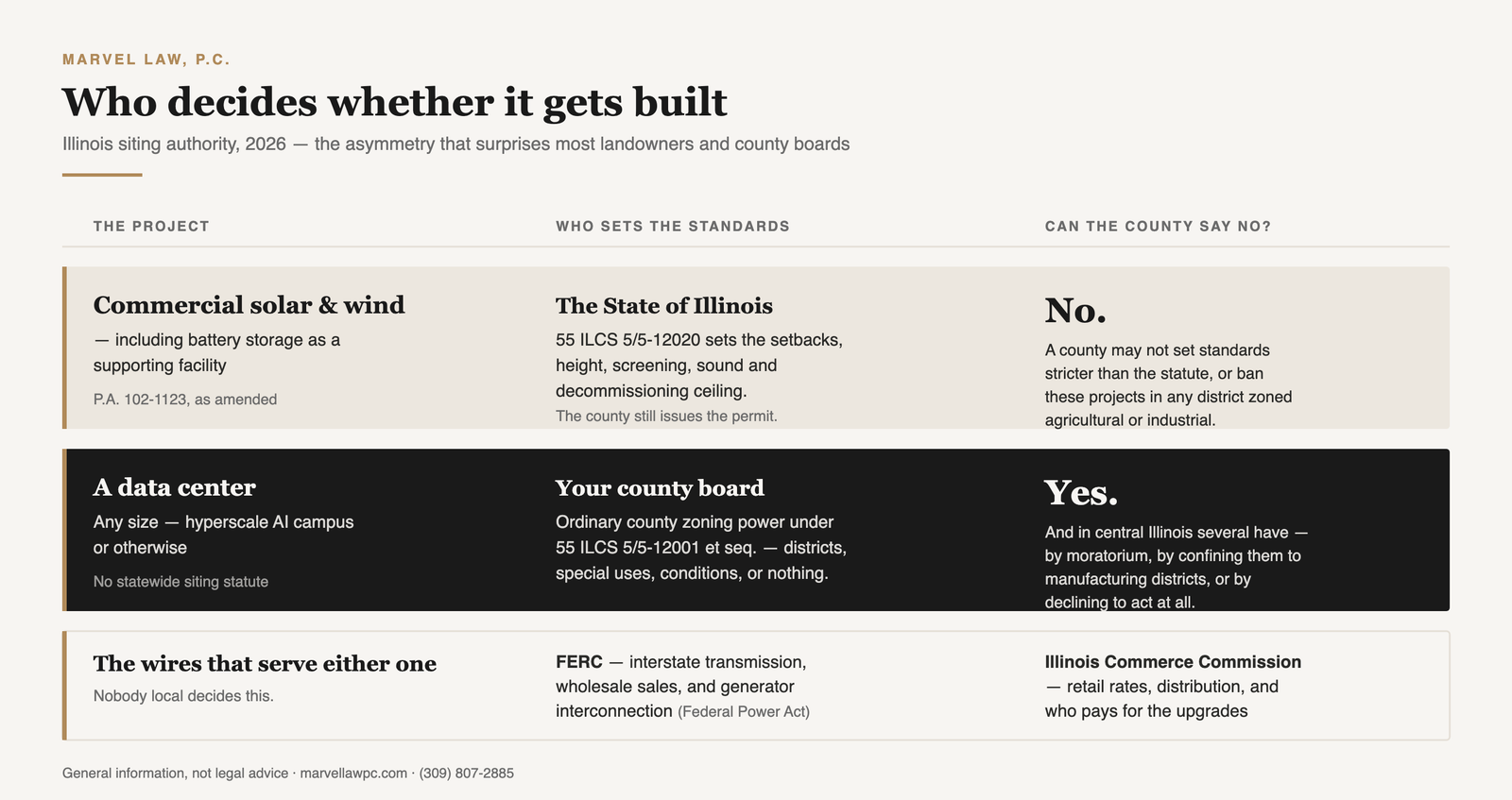
This cuts both ways, and it is worth being blunt about it. If a developer wants your ground for solar or a battery site, the county largely cannot stop it. If a developer wants your ground for a data center, the county absolutely can — and in this part of the state, several have.
What central Illinois has actually done
This is moving weekly. As of August 30, 2026, the picture in and around our practice area looks like this.
- Bloomington — a six-month moratorium, approved unanimously on May 26, 2026, reaching facilities designed for more than 5 megawatts, with at least two public hearings required during the pause. It runs to roughly the end of November 2026.
- Normal — a moratorium approved unanimously earlier in May, running through November 30, 2026.
- McLean County (unincorporated) — the county declined to pause and regulated instead, and its rules are now among the most detailed in the region. Data centers were made a special use in October 2025. In March 2026 the county limited them to M1 and M2 manufacturing districts, expressly to keep them off farm ground. On June 11, 2026 the county board adopted thirteen additional requirements: landscape screening where the facility is visible from a dwelling within 500 feet; shielded lighting with no glare past the boundary; a road use agreement; an emergency plan plus training or equipment for the fire protection district; documented water volume, source, treatment and wastewater handling; disclosed peak electrical load and power sources; renewed notice if the energy requirement rises by more than 20 percent; accessory battery storage capped at 5 megawatts serving only the facility; Illinois Pollution Control Board noise limits; disclosure of backup generation type, fuel and expected run hours; an infrastructure impact assessment; a decommissioning plan with a licensed engineer's cost estimate; and demonstrated efforts to minimize the footprint.
- Logan County — the cautionary tale, and worth walking through in detail below. A 60-day moratorium in February, then a twelve-month moratorium passed 6–4 on May 19, 2026. In June, State's Attorney Bradley Hauge concluded the twelve-month moratorium was invalid because it had not gone through the zoning process before the board voted. Days later the board failed, 5–6, to adopt a data center zoning ordinance. So the county entered the summer with no moratorium and no data center ordinance — while Hut 8's proposed $5 billion, 500-megawatt Logan Prairie project sat pending on roughly 200 acres in Laenna Township, west of Latham.
- DeWitt County — the county board voted unanimously not to send a data center ordinance to its zoning board of appeals. That is not a ban and not a moratorium. It is a decision not to start, and the board chair has been clear that part of the difficulty is drawing a line between a hyperscale campus and the ordinary server rooms local businesses and county offices already operate.
Outside our immediate area, Effingham, Bourbonnais, Carbondale, Champaign County, Macon County, Morgan County and Lake County have all moved on some version of the same question. This is not a local peculiarity. It is a statewide pattern, and it happened fast.
The Logan County lesson: a moratorium is a zoning act
If you take one practical thing from this article, take this one. A pause on accepting or processing applications for a particular use is a change to how the zoning ordinance operates. Under the Counties Code, zoning amendments and variations run through the zoning board of appeals with published notice and a public hearing before the county board acts — see 55 ILCS 5/5-12009. Skip that step and you have handed the developer a clean argument that the moratorium never bound anybody.
That is precisely what happened in Logan County. The board voted, the developer's counsel wrote a letter, and the county's own prosecutor advised that the ordinance had not been properly adopted. Months of political effort produced nothing enforceable.
The related fight is about timing. Illinois courts recognize that a developer can acquire vested rights by making substantial expenditures or incurring substantial obligations in good-faith reliance on the probability that a permit will issue. The doctrine has a hard edge, though: once a developer knows a zoning change is likely coming, it can no longer claim good-faith reliance for what it spends after that. So whether a pending application is caught by a new moratorium turns on what was filed, when, what was spent, what the developer knew, and whether the moratorium was validly adopted in the first place. There is no clean rule. There is a record, and whoever built the better one usually wins.
What Logan County shows about how these fights are actually run
Once the moratorium fell and no ordinance replaced it, Hut 8 ran two tracks at once. That is the part worth studying, because it is the playbook.
Track one: get in before the rules do. Hut 8's position has been that because it applied before any new ordinance passed, it cannot be held to an ordinance adopted afterward. That is a real argument, not a bluff — it is the vested rights and pending-application problem from the other direction, and it is why the sequence of dates matters more than the strength of anyone's feelings. A county that debates for six months and legislates in the seventh may find the project it was worried about is already outside the new rules.
Track two: change who decides. Hut 8 also asked the Village of Latham — a village of a few hundred people, a couple of miles from the site — to annex and rezone the ground, with a community benefit agreement reported in the range of $8 to $11 million a year. Annex the parcel and county zoning stops applying. The decision moves from a county board of twelve to a village board of a handful, in a community for which that money is transformative.
There is nothing improper about either move. Annexation is a lawful tool, and Illinois law lets municipalities annex and zone contiguous territory. But it is a reminder that in a land use fight the threshold question is rarely "what are the standards" — it is who gets to apply them, and whether that can be changed while you are arguing about something else.
Neither track has landed. Latham cancelled its August 3 vote after the village president polled trustees and concluded it would fail. The county tabled the applications at the Regional Planning Commission and zoning board of appeals in early August over technical defects the State's Attorney identified and Hut 8 disputes; corrected applications could be heard in September at the earliest. The project has not been withdrawn.
The farm ground question people get backwards
Illinois counties cannot use zoning to eliminate uses on land used for agricultural purposes where farming is the principal activity. That exemption, in 55 ILCS 5/5-12001, is why farmers are used to hearing that the county cannot tell them what to do with their own ground.
It does not help here. The agricultural exemption protects farming from zoning. It does not protect farmland from being converted to something that is not farming. Once a data center is the principal activity on the parcel, there is no agricultural use left to shelter. Which is also why McLean County's decision to confine data centers to manufacturing districts has real teeth: it is not a technicality, it removes agricultural ground from the board entirely.
If an offer has landed on your ground
Approval risk is now the dominant risk in these deals, and it is not distributed the way most landowners assume.
- The option is the whole negotiation. Option payments are modest. The option term, the extension rights, and what happens if a moratorium or an appeal stretches the timeline decide whether your ground is tied up for two years or six while the developer chases a permit that may never issue.
- Ask who carries the zoning risk. Most drafts put it on you in the form of time — the developer keeps extending, you keep waiting, and you cannot market the land meanwhile.
- A data center offer and a solar or storage offer are not the same animal. They can look nearly identical on paper and carry completely different odds of approval in the same county. Which document is on your table changes what you should be asking for.
- Watch the exclusivity and assignment clauses. Being locked out of every other conversation while a developer decides whether it wants your parcel is a real cost, and it is negotiable.
If you are the neighbor
Special use hearings are where these projects are actually decided, and the record built at the zoning board of appeals is what a court reviews later if it comes to that. Generalized opposition does not travel well. Specific evidence does.
- Get the water numbers on the record — volume, source, whether it is groundwater, and what happens to the wastewater.
- Get the backup generation on the record — fuel, capacity, and expected annual run hours.
- Get sound measured at the property line, against the Pollution Control Board limits, not in the abstract.
- Get road use, haul routes and restoration in writing, not in a promise from the podium.
- Get decommissioning security quantified by an engineer, and ask who holds it.
- Check the notice. Defective notice is the single most common vulnerability in a county land use approval, and it is worth verifying before the hearing rather than after.
Conditions attached to a special use are enforceable. Assurances offered during public comment are not. If it matters to you, it needs to end up in the ordinance.
Where this is heading
Springfield has not settled this. The POWER Act did not advance in the spring 2026 session, and in June the Governor paused new state tax incentives for data centers while calling for a broader framework — we cover that in Illinois Paused Data Center Tax Incentives. Here's What That Actually Means. Until the legislature acts, the decisions are being made in county boardrooms and village halls, ordinance by ordinance, hearing by hearing.
Our firm handles the county siting and zoning side of these projects and reviews the land agreements that come with them. If a data center question has reached your ground, your subdivision, or your board, the useful conversation happens before the hearing.