
For about twenty years, electricity demand in the United States was essentially flat. Utilities planned around replacement, not growth. That period is over, and it ended abruptly enough that most of the industry did not see it coming — a point made bluntly in a recent Hogan Lovells continuing legal education program on powering data centers, where the presenter said that if you had asked him in 2024 to name the five biggest issues facing the power sector, data centers would not have made the list.
That matters to our clients for a reason that is not obvious. The strain data centers are putting on the grid is what is driving developers onto central Illinois farmland looking for battery sites, and it is quietly changing what is actually valuable in an energy lease.
The mismatch that explains everything else
A data center can be built in a matter of months. New generation, run through the interconnection queue, can take on the order of six years. A new transmission line can take up to ten. That is the whole problem in three sentences.
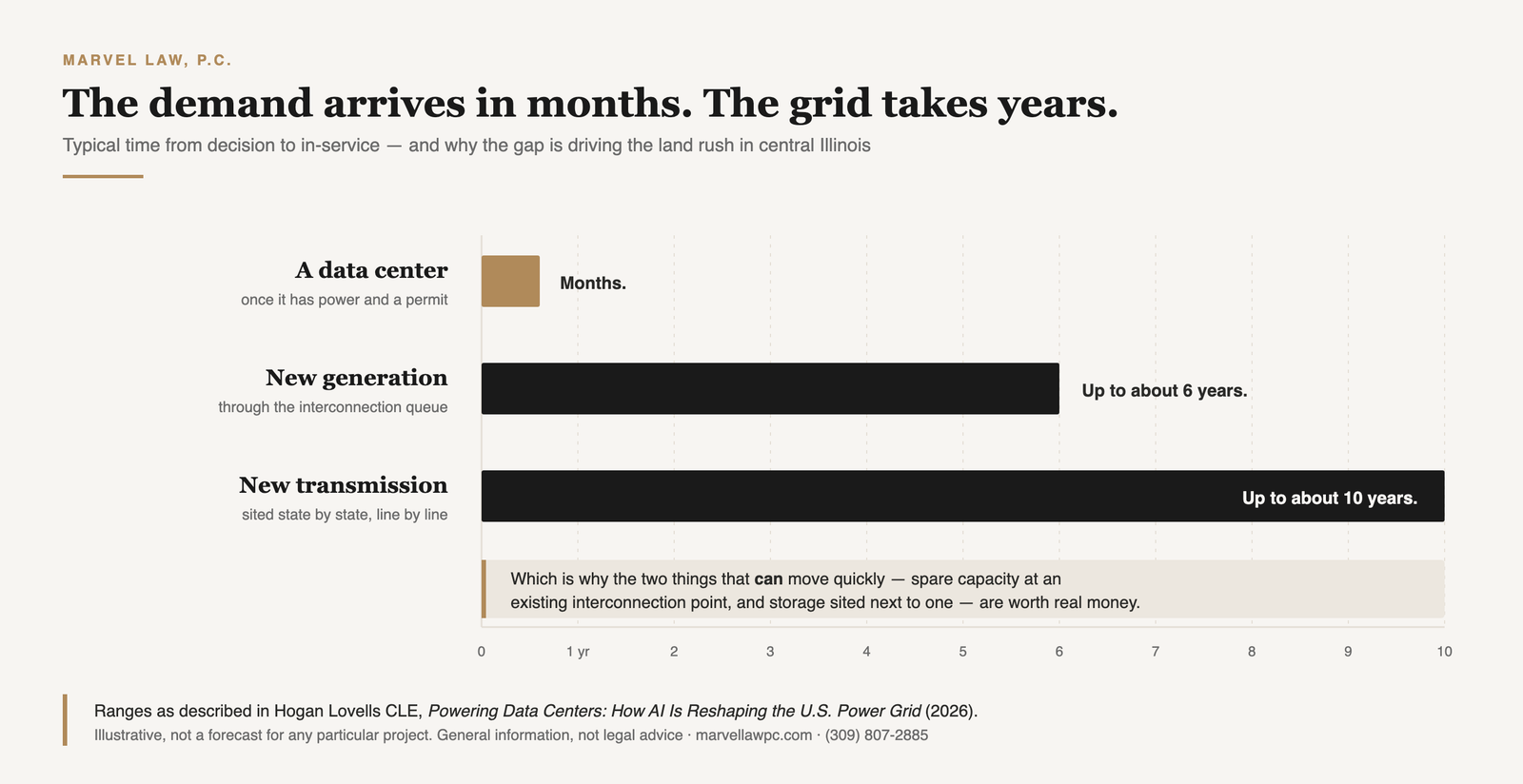
Two things make the delay structural rather than temporary. The first is the interconnection queue. A generator that wants to connect files a request, and the utility studies its effect on the system. Because those studies are interdependent, one developer dropping out forces the others to be restudied. Queues across the country have been backlogged for years, and every round of federal reform has fallen short of fixing it.
The second is that transmission is sited state by state. Under the Federal Power Act, FERC governs interstate transmission and wholesale sales — but the states kept the authority to approve where a line actually goes. A line crossing three states runs three separate approval gauntlets, each with its own politics. It is a large part of why the country has not built much high-voltage transmission in a generation.
Who is actually in charge — and who is not
People assume somebody is coordinating this. Nobody is, exactly.
The Federal Power Act split the grid in two, and the split still governs. FERC has jurisdiction over wholesale sales, interstate transmission, and how generators interconnect. The states got everything else — retail sales to the end user, the distribution lines in your town, energy policy, and the siting of transmission. In Illinois that state authority sits with the Illinois Commerce Commission, which is where the fights about who pays are happening.
What is missing from that structure is anyone with authority over the whole problem. There is no body that can decide a data center goes here, the generation goes there, and the line connecting them gets built on this schedule. Notably, none of it is decided locally either — your county board has real power over whether a data center gets built on a given parcel, which we cover in What Your County Can and Can't Do, but no power at all over the grid that would serve it.
The shortcut that did not work
Faced with a six-year wait, some developers tried to skip the grid entirely — connecting a data center directly behind an existing power plant rather than through the transmission system. The prominent attempt involved a large data center proposed behind the Susquehanna nuclear facility in the mid-Atlantic.
FERC rejected it. The reasoning is worth understanding, because it is the same reasoning showing up in state rate cases now. A facility connected behind the meter is not taking transmission service and so is not paying for it — but it still depends on the grid being there, and pulling that much existing generation off the system has the same practical effect as retiring it. Everyone else absorbs the consequences.
Cost allocation is the real fight
Ask people in this field what to watch and the answer is not technology. It is cost allocation — who pays for the interconnection, the substation, the upgrades further up the line, and the capacity built to serve a load that may or may not show up.
The interesting part is that the developers are largely not refusing to pay. The problem is that the rate structures were built for an era of flat demand and do not cleanly measure what a load of this size actually causes. When an upgrade is needed partly because of a new data center and partly because a town grew, somebody has to decide the split — and the existing rules were not written for that question.
Illinois is working on it. In March 2026 the Commerce Commission approved a revised ComEd tariff raising security deposits for large-load customers and opened a broader investigation into shielding residential and small business customers from data center-driven distribution costs. Keep in mind that ComEd does not serve this region — McLean, DeWitt and Logan counties are Ameren Illinois territory — so the specific tariff does not apply here even though the Commission's thinking will carry downstate.
Why this lands on your farm ground
Here is the connection to the lease on your kitchen table.
If new generation takes six years and new transmission takes ten, then the two things that can move on a useful timeline are spare capacity at an existing interconnection point and storage sited next to one. Batteries can be deployed faster than almost anything else on the system, they smooth the peaks that large loads create, and Illinois is actively buying them — the Clean and Reliable Grid Affordability Act set a 3,000 megawatt storage target and directed the Illinois Power Agency to run procurements, with the first, of roughly 1,038 megawatts, due by late August 2026. We covered what that changed for landowners in Illinois' New Battery Storage Law.
That is why a farm two counties from any data center is suddenly getting mail. The developer is not interested in your soil. It is interested in your proximity to a substation with headroom — and headroom is finite and going fast.
What it should change in your lease
If interconnection access is the scarce asset, then the clauses that control interconnection access are the ones worth negotiating, and they are usually the ones landowners skim past.
- Do not hand over the whole parcel's grid position for one project's rent. Many drafts take easements and interconnection rights across ground the developer is not paying rent on. If your parcel's value to the grid is what is being purchased, price it.
- Expansion rights and rights of first refusal. A right of first refusal over your entire property, granted for a project on forty acres, is the developer capturing the scarcity for free. This is negotiable and frequently negotiated out.
- Assignment. Interconnection position is itself a tradeable asset. Know whether the counterparty you negotiated with can hand the lease to someone you have never heard of, and what survives if it does.
- Curtailment and revenue. If rent is tied in any way to output or revenue, understand what happens when the project is dispatched down. Get the definitions in writing.
- The option period. Given the queue timelines above, an option can tie up your ground for years before operating rent ever begins. Option payments should reflect the real length of the wait, not the optimistic one.
- Decommissioning security. Thin security is the recurring problem in these agreements. Ask what happens if the project is abandoned mid-queue, which given current backlogs is not a hypothetical.
We go through the rest of these provisions in detail in Sent a Solar or Battery Lease? Read It Before You Sign.
The honest summary
Nobody knows how much of the projected demand is real. There is credible talk of a bubble, efficiency gains will eventually cut consumption per unit of computing, and the same developer often runs four or five sites in parallel while only one gets built — which means the utility forecasts almost certainly overstate what arrives.
That uncertainty is a reason to negotiate carefully, not a reason to wait. Illinois is buying storage on a statutory schedule. Interconnection headroom is finite. If a developer has approached you, the leverage exists right now, and it exists because of a scarcity most landowners do not know they are sitting on.
Our firm reviews and negotiates these agreements for landowners across central Illinois, and handles the county siting and zoning side as well. Bring us the offer before you sign anything — including the option. The option is a contract too.